
Market reactions to recent regional developments and what it means for long-term investors.
– Prepared 4 March 2026 (as of 11am GST)
Key Takeaways
- Recent escalation between the United States, Israel and Iran has increased geopolitical uncertainty across the Middle East.
- Financial markets have reacted in a typical way to geopolitical events, with oil and gold rising while global equities have declined amid increased uncertainty.
- Investors are closely watching shipping through the Strait of Hormuz, a critical route for global energy supply.
- Markets remain orderly and functioning normally, and long-term investment discipline remains important during periods of volatility.
Situation overview
Tensions in the Middle East have escalated in recent days following reports of strikes involving the United States, Israel and Iran, alongside retaliatory missile and drone activity across parts of the Middle East region. Regional authorities have also reported aerial interceptions and heightened security responses across several Gulf states.
While the geopolitical situation remains fluid, financial markets have so far reacted in a relatively measured and familiar way.
Energy prices have moved higher, traditional safe-haven assets such as gold have strengthened, and equity markets have declined as investors price in a higher degree of geopolitical uncertainty.
As of 4 March:
- Brent crude oil is trading around $83 – $84 a per barrel
- Gold has risen approximately 1.55%
- S&P 500 futures are modestly lower, by roughly 1–1.5%
(Sources: Reuters market reporting, 3–4 March 2026).
What markets are watching
The most important transmission channel for global markets in the current environment is energy. The Strait of Hormuz, through which roughly 20% of global petroleum liquids consumption passes, remains a key focal point for investors.
(Source: U.S. Energy Information Administration).
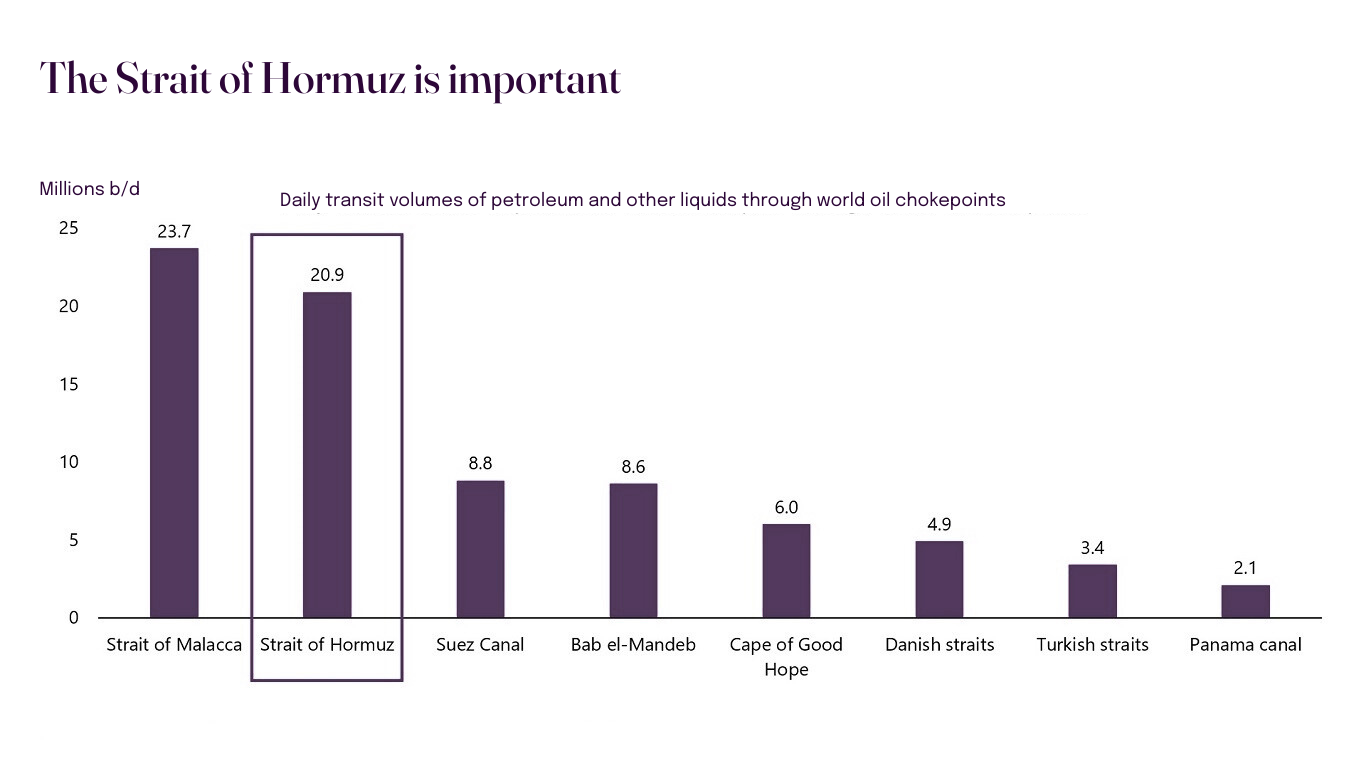
Source: U.S. Energy Information Administration (EIA); Apollo Chief Economist analysis based on Vortexa tanker-tracking data.
Shipping activity has become more cautious, and insurance costs have increased, although maritime traffic continues and global energy markets remain operational. Vessel-tracking data cited by Reuters shows tanker movements slowing as shipping companies assess security conditions in the region.
(Sources: Reuters; Vortexa vessel-tracking data).
At present, markets appear to be pricing heightened uncertainty rather than a sustained disruption to global energy supply.
Authorities across the UAE and wider Gulf region have confirmed that security measures are in place, and regional infrastructure and financial markets continue to operate normally.
Portfolio perspective
Periods of geopolitical tension can be unsettling, but are not unusual in financial markets. Diversified portfolios are designed with these environments in mind.
Across asset classes, we often see natural offsets during periods like this:
- Energy companies within global equity markets can benefit from higher oil prices
- Government bonds often attract demand as investors seek stability during periods of uncertainty
- Short-duration bonds and money market funds can help provide stability and liquidity when volatility increases
- Global diversification across sectors and regions helps reduce reliance on any single economic outcome
These dynamics help reduce the impact of short-term volatility on balanced portfolios.
History also shows that geopolitical events can cause short-term volatility, but their long-term impact on diversified portfolios is often limited once markets adjust to new information.
Staying disciplined
News flow during geopolitical events can be intense and sometimes sensational. It is important to distinguish between the tone of headlines and the underlying behaviour of financial markets.
At present, we are not seeing signs of disorderly trading conditions or systemic financial stress.
For long-term investors, the most important response is to remain calm and disciplined. Reacting emotionally to short-term market movements can often be more damaging than the events themselves.
Our approach remains grounded in evidence-based investing, focusing on diversification, long-term discipline and financial science rather than reacting to short-term geopolitical headlines.
We will continue monitoring developments closely and will provide further updates should market conditions materially change. Our long-term investment philosophy remains unchanged.
Get in touch
Contact GSB today if you would like to discuss any of these matters with our in-house team.
Contact us
Sources
- Reuters geopolitical and market reporting (3–4 March 2026)
- S. Energy Information Administration – Strait of Hormuz oil flow data
- Vortexa vessel-tracking data cited by Reuters
- GCC Secretariat and regional government statements
Disclaimer
This material is provided for informational purposes only and does not constitute investment advice, an offer, or a solicitation to buy or sell any financial instrument. The views expressed reflect market conditions and publicly available information at the time of writing and may change without notice.
Past performance is not a reliable indicator of future results. All investments involve risk and the value of investments can go down as well as up.
This commentary should not be relied upon as the basis for making investment decisions and does not take into account the specific objectives, financial situation, or needs of any particular investor.
GSB is a pending trademark of GSB Capital Ltd, which is registered with the Dubai International Financial Centre (DIFC), licence no. CL4377, and regulated by the Dubai Financial Services Authority (DFSA) under licence no. F006321. The registered address is Office 901, Floor 9, West Wing, The Gate, Dubai International Financial Centre, PO Box 938542, Dubai, UAE.