
There is a scenario I encounter more often than you might expect. A successful entrepreneur, a founder, a senior executive. Built something real. Earns well. Has accumulated substantial wealth over a decade or more in the UAE. And when you sit down to map out where that wealth sits, the picture is often consistent: a large portion of wealth is in property.
Not just any property, but increasingly UAE property. Often Dubai specifically. Sometimes spread across three or four properties, occasionally concentrated in one or two.
On paper, the numbers could be seen to justify this. Dubai real estate has performed exceptionally well for those who got in at the right time. Values have risen sharply, rental yields averaging 6% to 7% annually, compared favourably to the 2% to 3% typical of London or New York, and the city continues to attract serious international capital. The UAE added over 7,200 millionaire residents in 2024 alone, a 53% increase on the prior year, and the vast majority of that incoming wealth has found its way into property.
But there is a difference between an asset class performing well and a portfolio being well constructed. And right now, with the geopolitical landscape shifting faster than at any point in recent memory, that distinction matters more than it has in years.
What is concentration risk, and why does it matter for UAE property investors?
Most of the clients I work with at this level did not set out to build a real estate portfolio. They bought a home. Then an investment property. Then an off-plan unit that looked compelling. Then another. Over time, and without ever making a deliberate strategic decision, they ended up with 80% or 90% of their net worth tied to a single asset class, in a single jurisdiction, denominated in a single currency. That is concentration risk.
It is not a character flaw. It is an entirely rational response to an environment where property delivered strong returns and felt tangible and controllable in a way that global markets sometimes do not. But it creates a structural vulnerability that tends to go unexamined until something in the environment changes.
And at the beginning of 2026, the environment changed.
Why 2026 is a pivotal moment for UAE investors
The outbreak of conflict involving Iran in early 2026 brought that question into sharp focus for many of the clients and prospects I speak with. But even before that, something had shifted. Geopolitical instability, shifting trade dynamics, dollar strength, and questions about the long-term trajectory of emerging market real estate were already weighing on the minds of serious wealth holders in ways they simply did not before.
None of this means Dubai property is heading for a cliff. I am not making that argument and I never would; I remain very constructive about the region and the longer term growth aspirations, despite the conflict. But the argument I am making is as follows: that betting the majority of your life’s wealth on any single outcome, however probable it seems, is a structural risk that no reasonable financial plan should accept.
When the majority of your wealth is illiquid, geographically concentrated, and tied to the performance of one market, you have very little room to manoeuvre if circumstances shift. That is true whether the shift is external, as we are seeing now in the broader macro environment, or personal: a business sale, a health event, a change in residency plans, a desire to step back from the pace of work you are keeping today.
Closer to home, Knight Frank’s Q3 2025 Dubai Residential Review flagged an oversupply risk emerging in the market, noting that only 46% of promised housing was completed on time in 2025, and that supply may begin to outpace demand in certain segments of the market. That is not a crash prediction. It is a signal that the one-directional assumption many property-heavy investors have built their financial lives around deserves scrutiny.
J.P. Morgan’s analysis of over 80 years of market data found that geopolitical events generally have no lasting impact on large cap equity returns. However, geopolitics can have profound market impacts at the local level. That asymmetry is precisely the point. A globally diversified portfolio tends to absorb geopolitical shocks and recover. A portfolio concentrated in a single local market does not have that same cushion.
How to build a more balanced investment portfolio from a UAE real estate base
The clients who tend to feel most secure about their financial future are rarely those who pursue the highest returns. More often, they are the ones who approached their balance sheet deliberately, building diversification across asset classes, geographies, currencies, and liquidity profiles in a structured way over time.
When you compare the asset allocation of many property-heavy private investors against long-term institutional pools of capital such as sovereign wealth funds, endowments, and established family offices, the contrast is often striking. Institutional investors rarely allow a single asset class to dominate their financial future to the degree many successful entrepreneurs unintentionally do.
For someone who has built significant wealth in UAE property, the question is rarely whether to sell assets. More often, it is about how to use that asset base strategically to create liquidity, broaden opportunity, and reduce concentration risk without dismantling what has already been built.
That may involve using existing equity to establish an offshore private banking relationship that opens access to global public markets, private credit, and alternative investments. It may involve a phased release of capital from the portfolio over time, redeploying it into evidence-based investment strategies designed to generate long-term returns ahead of the cost of capital.
In many cases, it begins with something far simpler: a consolidated view of the balance sheet. Assets, liabilities, income streams, liquidity requirements, future obligations, and long-term objectives viewed together, rather than as a series of disconnected decisions accumulated over time. From there, cashflow forecasting, liquidity planning, financing strategy, investment allocation, and succession considerations begin to operate as part of a single framework rather than separate conversations.
Ultimately, the goal is rarely just to accumulate more wealth. It is to reach a point where financial decisions become driven by choice rather than obligation. That requires a plan. Not a collection of isolated decisions made over years without a connecting strategy, but a deliberate framework built around a specific long-term outcome.
When the headlines are loud, the fundamentals still speak
It is worth pausing, in moments like this, to ask a simple question: does what is happening in the world right now materially change the long-term outlook for the businesses inside a well-constructed global investment portfolio? For most high-quality companies, the honest answer is no. Businesses across technology, consumer goods, healthcare, and industrials continue to operate, serve customers, generate cash, and compound value over time.
Historical data suggests that reactive decision-making can materially impact long-term returns. J.P. Morgan’s analysis of S&P 500 returns between 2003 and 2022 found that seven of the ten best single days in the market occurred during bear markets. Miss those days by coming out of the market to sit on the sidelines, and your long-term returns fall dramatically. The discipline to remain invested, not the ability to time the market, is what separates investors who build lasting wealth from those who do not.
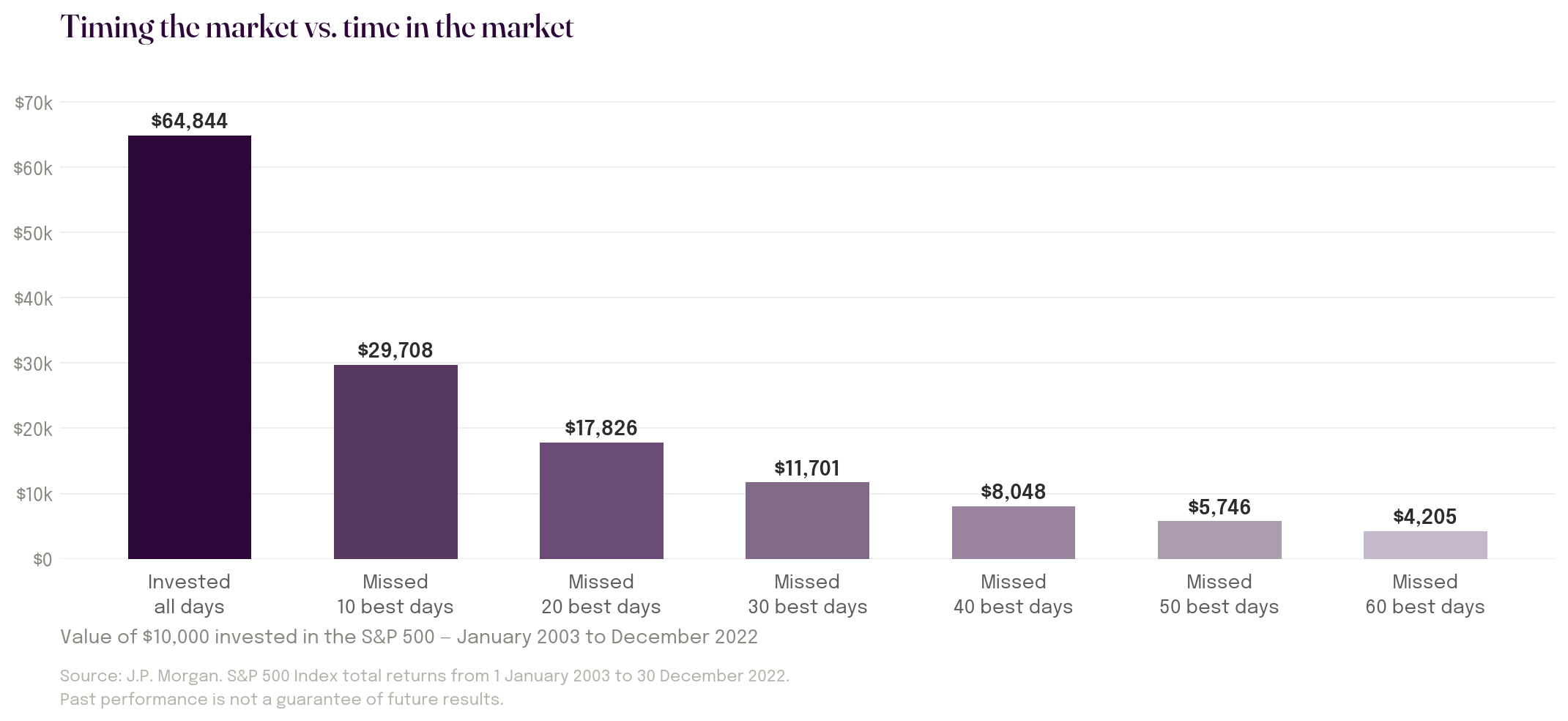
Illustrative historical analysis based on past market performance; future outcomes are not guaranteed.
This is the case for real diversification. Not as a reaction to headlines, but as a structural decision made before the headlines arrive. A portfolio spread across asset classes, geographies, and currencies does not eliminate discomfort. But it means that no single event, whether a regional conflict, a market correction, or a shift in the Dubai property cycle, can define your entire financial position.
The investors who have built lasting wealth are not those who moved fastest or took the biggest risks. They are, almost without exception, the ones who had a plan, built diversification into it, and held their nerve when the environment made that difficult.
Why independent advice matters
The ability to do this well depends heavily on the quality and independence of the advice surrounding you.
Most successful entrepreneurs and senior executives already have access to products. What they often lack is coordination: an independent adviser capable of looking across the entire balance sheet, across jurisdictions, and across banking & custodian relationships, without being tied to the limitations of a single institution.
Remember, traditional private banking relationships are often shaped by the platforms, capabilities and commercial frameworks of the institutions through which they operate. This is not a criticism of individuals, but simply a reflection of how many banking environments are structured.
We operate as an External Asset Manager (services are subject to suitability, jurisdictional permissions and individual circumstances), helping clients bring structure, coordination, and long-term strategy to complex wealth. Rather than being tied to a single bank or custodian, we work across a network of leading private banking institutions to help clients access solutions aligned to their objectives, liquidity needs, and long-term plans.
Your assets remain in your name at all times. Our role is to help ensure the structure around them evolves alongside your life, your family, and the future you are building toward.
That model becomes especially valuable when the question is as significant as this one: how do you take a portfolio that has already created substantial wealth and evolve it into something capable of supporting every stage of life that comes next?
A final thought
The clients who engage with this question early, while they still have optionality, always end up in a stronger position than those who wait until a specific event forces their hand.
If 80% or more of your wealth is sitting in a single asset class in a single jurisdiction, such as Dubai real estate, and you do not have a plan for what comes next, now is a reasonable time to start that conversation.
Real diversification is not about abandoning property or reacting emotionally to headlines. It is about creating clarity and control across every dimension of wealth before circumstances force those decisions upon you.
Get in touch
Contact GSB today if you would like to discuss any of these matters with our in-house team.
Contact us
Disclaimer
This article has been prepared by GSB Capital Ltd, which is registered with the Dubai International Financial Centre (DIFC), licence no. CL4377, and regulated by the Dubai Financial Services Authority (DFSA) under licence no. F006321. The registered address is Office 901, Floor 9, West Wing, The Gate, Dubai International Financial Centre, PO Box 938542, Dubai, UAE.
This article is intended for individuals based in the UAE and is directed only at persons to whom GSB Capital Ltd is permitted to communicate financial promotions under the rules of the DFSA. It does not constitute financial advice and should not be relied upon as such. The value of investments can fall as well as rise, and you may get back less than you invest. Past performance is not a reliable indicator of future results. If you are based outside the UAE, this content may not be appropriate for you, and you should seek advice from a suitably qualified adviser in your own jurisdiction.