
I have been a financial planner in Dubai since 2019; before that, living in Kuala Lumpur and Cairo. In that time, I have had the opportunity to review several portfolios belonging to British expats who believed their finances were in good shape.
Many contained areas that could potentially be improved. The same three problems come up so often that I can spot them within the first ten minutes of a conversation. They are not complicated, they are not hidden, but they may be costing some investors real money without them realising it.
Around one in ten portfolios I review today still contains a long-term insurance-based structure with active surrender penalties. That figure was far higher when I started. Progress has been made, but not enough.
If any of this sounds familiar, it does not mean you have received ill-advice. It might just mean you deserve better.
01
Locked in with penalties
02
A bond inside a pension
03
You have a portfolio, not a financial plan
Written by Craig Ritchie, Senior Partner at GSB.
1. You are locked in and paying surrender penalties
This is the big one. The one that makes me genuinely frustrated on behalf of clients.
You were sold an insurance company plan with a 15 to 25 year commitment period. You were told it was a savings plan. What you were not told is that the structure may involve significant upfront commission arrangements, depending on how it is implemented, clawed back from your returns over the life of the contract.
The result? You feel trapped. You know the charges are high, you can see them eating into your returns. But leaving looks like it costs more than staying, so you stay.
The results?
You feel trapped. You know the charges are high, you can see them eating into your returns. But leaving looks like it costs more than staying, so you stay.
I recently reviewed the arrangements of a couple, both holding Self-Invested Personal Pensions (SIPP) through a well-known provider. Between them, their combined pension value was just over £1.4 million. Their combined surrender penalty was over £37,000. Not because they had done anything wrong. Because the products they were sold carried a policy management charge of 0.95% per year applied against the original premium, payable for ten years.
They were three years from the end of that charging period and had no idea the penalty existed until they came to see me.
I have sat across from clients paying 2.5 to 3.5% per year in total charges. On £500,000, that is up to £17,500 every year. Over a decade, that could be £175,000 of your money, gone.
I want to be transparent: our own all-in fee at GSB is typically around 1.3%*. We are not free either. But the difference between our charges and those available in the market, compounded over 20 years, is significant.
The chart below shows what that gap looks like in practice.
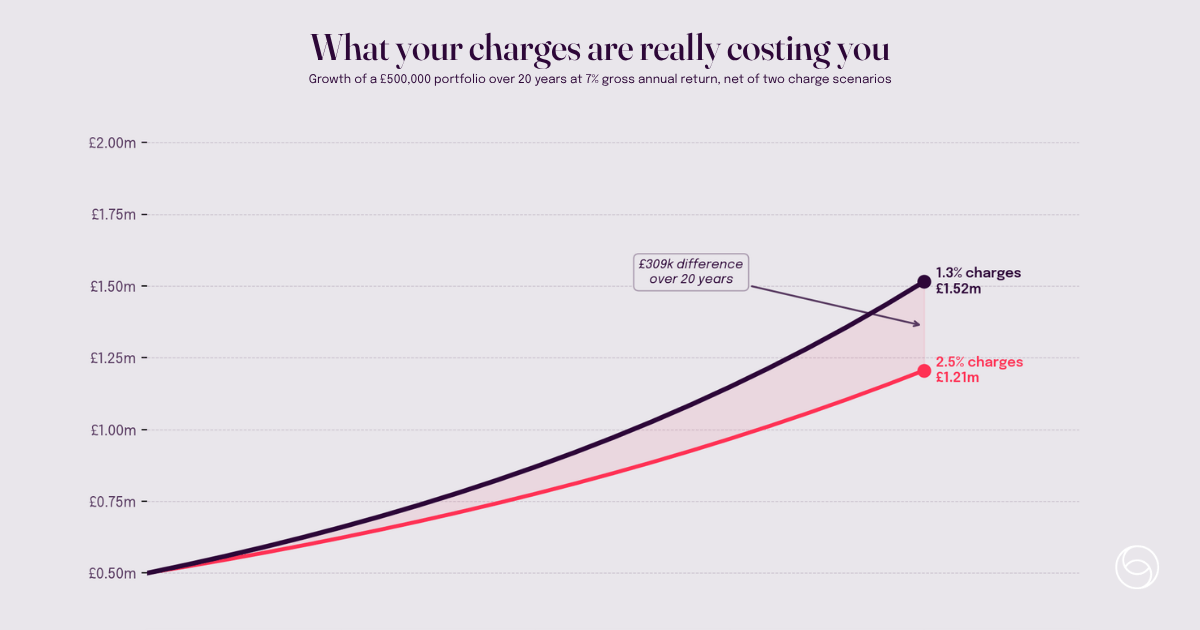
For illustrative purposes only. Assumes a starting portfolio value of £500,000 and a gross annual growth rate of 7%, with charges deducted annually. The two scenarios shown reflect total annual charge rates of 1.3% and 2.5% respectively. Past performance is not a reliable indicator of future results. The value of investments can fall as well as rise. This does not constitute financial advice.
Many modern platforms have no tie-in periods, no exit fees, and no surrender penalties, although terms vary by providers. If you are locked in with significant surrender penalties or exit restrictions, it is worth understanding why that structure was originally recommended and whether it remains appropriate for your circumstances today.
2. You have an investment bond inside a pension
Bear with me on this one because it matters more than most people realise.
A bond is a tax wrapper. A pension is also a tax wrapper. If your adviser has placed one inside the other, you are paying for two layers of wrapping when you only need one. That extra layer typically adds 1 to 1.5% per year in charges with little or no identifiable benefit in many cases. The couple I mentioned above had exactly this structure. Their SIPPs held bonds, which carried an annual policy management charge on top of their pension administration costs and fund charges. Three layers of cost. None of those layers delivered value that could not have been achieved more simply and at lower cost.
I see this most often with UK pensions transferred into an international SIPP or Qualifying Recognised Overseas Pension Scheme (QROPS). It was a common structure sold throughout the 2010s, and many people are still paying for it today without knowing why the bond is there.
My suggestion: ask your adviser, in writing, to explain why the bond is there and what benefit it provides that the pension wrapper alone does not. They should be able to give you a clear and documented rationale, which may help you assess whether the arrangement remains suitable for your circumstances. In my experience, a clear and specific answer is rarely forthcoming.
3. You have a portfolio but no financial plan
This is the most common problem and the hardest to spot. You have an adviser, a portfolio, a quarterly report. It all looks professional.
But let me ask you three questions.
When can you afford to stop working?
How much should you be saving to get there?
What happens to your family if something happens to you tomorrow?
If your adviser has never built you a cashflow model or sat down to answer any of those questions properly, you do not have a financial plan. You have a portfolio. A portfolio is money sitting somewhere. A plan is a roadmap that tells you whether it is enough, and what needs to change if it is not.
In my experience, very few British expats have ever had proper cashflow modelling done, unless they have specifically sought out a qualified adviser in a regulated environment. When we do it with clients for the first time, the reaction is almost always one of two things: a reality check that they need to save more and act faster, or a genuine sense of relief that they are already on track. I have had clients walk out of a cashflow session and begin planning their exit from work within months.
One client told me it felt like winning the lottery, not because he had suddenly become wealthier, but because for the first time, he could actually see that the money was there and the life he wanted was within reach.
If your adviser is managing your money but has never helped you build a financial plan, it may be worth considering whether your current arrangements are aligned with your wider financial goals and objectives.
What to do next
Do not panic and do not make sudden changes. If any of these warning signs sound familiar, ask your adviser to explain the rationale behind the recommendation and the costs involved. If you are not satisfied with the explanation, consider obtaining a second opinion from a qualified and regulated adviser.
A good adviser will tell you honestly whether your arrangements are working. If they are, I will say so. If they are not, a good adviser should be able to explain what could be improved and what options may be available.
You have worked hard for your money. You deserve to know whether the person looking after it is working just as hard for you.
Want a second opinion?
If you would like an independent review of your existing arrangements, speak to a qualified financial adviser. A fresh perspective may help you better understand your current structure, costs and long-term objectives.
Request Your Retirement Review
We work with a select group of internationally mobile professionals and families, typically with investable assets of $1 million or more. If that reflects your situation, we’d welcome a conversation.
Disclaimer
This article is provided for general information purposes only and does not constitute financial, investment, tax or legal advice. The views expressed are those of the author at the date of publication and should not be relied upon as a basis for making financial decisions.
Any examples or client scenarios referenced are anonymised and certain details may have been amended to protect confidentiality. Individual circumstances vary and outcomes will differ. Any figures, projections or illustrations are provided for illustrative purposes only and are not a reliable indicator of future performance or future outcomes.
Pension transfers, SIPPs, QROPS, investment bonds and other financial planning arrangements are complex and may not be suitable for all individuals. You should obtain personalised advice from a suitably qualified and regulated financial adviser before taking any action in relation to your pension, investments or financial planning arrangements.
GSB Capital Ltd is regulated by the Dubai Financial Services Authority (DFSA) under licence number F006321. The value of investments can fall as well as rise, and investors may not receive back the full amount originally invested. Past performance is not a reliable indicator of future results.
*Actual fees vary depending on the service and individual circumstances